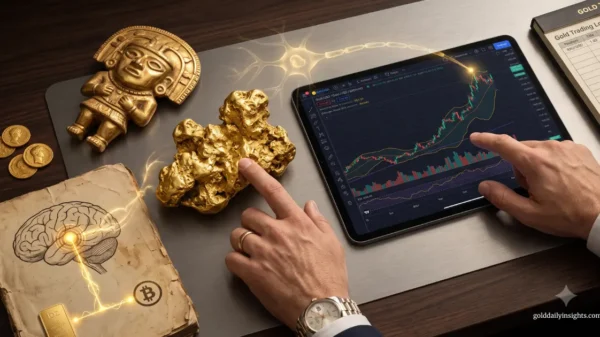
When I pull up my XAU/USD chart on MetaTrader 5, I am looking at one of the most liquid, efficient markets on the planet. Millions of ounces of gold change hands daily at the click of my mouse. Sitting here with my morning coffee, I often take this frictionless trade for granted.
But if I strip away the fibre-optic cables, the algorithms, and the digital ledgers, the foundational concept of the gold market I trade today remains exactly the same as it was over 2,500 years ago.
Someone had to be the first to standardise money. That breakthrough happened in an ancient kingdom called Lydia, and it completely transformed global finance.
The Problem with Early Commerce
Before coins existed, trade was a heavily fragmented and cumbersome process. Merchants operating around the Mediterranean and the Near East relied on bartering goods or using raw chunks of precious metals.
If a merchant wanted to buy grain with gold, they could not simply hand over a piece of metal. The transaction required scales to check the weight and a touchstone to test the purity. Every single trade was a slow, high-friction negotiation. Imagine trying to execute a high-frequency trade today, but having to manually assay the gold every time you opened a position. To me, it sounds like a logistical nightmare that heavily bottlenecked economic growth.
Enter the Lydian Lion
Around 600 BC, the Kingdom of Lydia—located in the western part of modern-day Turkey—found itself at the geographical crossroads between the wealthy empires of the East and the growing city-states of the Greeks to the West. The Lydians were traders by nature, and they needed a better way to do business.
The region was rich in a naturally occurring river alloy of gold and silver known as electrum. Under the reign of King Alyattes, the Lydian state did something entirely unprecedented. They took small, carefully weighed lumps of electrum and stamped them with the emblem of a roaring lion.
That simple stamp changed everything.
The Lydian Lion was not just a piece of art; it was a state guarantee. The King’s seal assured the merchant that this specific piece of metal possessed an exact, predetermined weight and purity. You no longer had to weigh it or test it. You could simply count it. Standardised liquidity had officially entered the market.
The Shift to Pure Gold
While the electrum stater was a revolutionary step, it had a flaw. Because electrum was a natural alloy, the exact ratio of gold to silver could fluctuate, making precise valuations tricky.
It was Alyattes’ son, King Croesus, who solved this problem and cemented Lydia’s legacy in financial history. Croesus introduced a metallurgical breakthrough: refining electrum to separate the gold from the silver. He then introduced a bimetallic system, minting coins of pure gold and pure silver.
These pure gold coins, often called Croeseids, were essentially the ancient equivalent of the modern 1-ounce bullion coin. For the first time in human history, there was a universally recognised, standardised unit of pure gold. It spurred an economic boom, making Croesus so wealthy that the phrase “rich as Croesus” remains in the English lexicon today.
What This Means for My XAU/USD Trading
It is easy to view ancient history as disconnected from my modern trading desk. However, the Lydian innovation of standardisation is the direct ancestor of the spot gold market.
When I trade XAU/USD, I am trading a standardised contract based on the Troy ounce, backed by strict London Bullion Market Association (LBMA) purity standards. The trust that allows me to buy or sell gold instantly without physically inspecting the metal is the exact same mechanism of trust King Alyattes created when he stamped a lion into a piece of electrum.
The Lydians figured out that gold’s real utility in commerce was unlocked through standardisation. Today, as fiat currencies fluctuate under the weight of inflation and central bank policies, gold continues to serve its ancient purpose: acting as a reliable, universally recognised store of value. My charts may be digital, but the underlying psychology of the asset remains deeply rooted in those first metal discs struck in Anatolia.
Frequently Asked Questions About Gold History
Who invented the very first coin?
The first true coins were invented by the Kingdom of Lydia (in modern-day Turkey) around 600 BC under King Alyattes. When I look at financial history, these early electrum coins, stamped with a lion’s head to guarantee weight and value, are the clear starting point for the currency markets we trade today.
What is an electrum coin?
Electrum is a naturally occurring alloy of gold and silver, often containing trace amounts of copper. The Lydians harvested this natural river metal to mint the world’s first currency. I find it fascinating that before pure gold was isolated for coinage, traders relied on this natural blend.
Why did King Croesus create pure gold coins?
King Croesus realised that the varying gold-to-silver ratio in natural electrum made precise valuations difficult. He introduced refining techniques to separate the metals. By creating a bimetallic system of pure gold and silver, he vastly improved trade efficiency, paving the way for the strict gold standards I monitor today.
How much is a Lydian Lion coin worth today?
The value of a Lydian Lion depends heavily on its condition, rarity, and denomination. I have seen common smaller denominations sell for a few thousand pounds on the numismatic market, while well-preserved full staters can fetch tens of thousands at auction due to their historical significance.
Why is standardisation important in the gold market?
Standardisation eliminates the need to manually weigh and test metals during transactions. Just as the Lydian stamp guaranteed a coin’s value, modern standards like the Troy ounce allow me to buy and sell XAU/USD instantly on my platform with complete confidence in the underlying asset’s worth.
How does the history of gold affect XAU/USD prices?
While daily XAU/USD fluctuations are driven by economic data, the historical perception of gold as a safe-haven asset underpins its long-term value. I always keep in mind that millennia of human trust in gold’s purchasing power is what gives my technical charts their fundamental weight.
Where was the ancient Kingdom of Lydia located?
The Kingdom of Lydia was located in the western part of modern-day Turkey, primarily in the region of Anatolia. Its geographical position placed it perfectly between the wealthy Eastern empires and Greek city-states, which I believe naturally forced them to innovate in cross-border trade.
What did people use for money before coins?
Before coins, merchants used the barter system or traded raw chunks of precious metals, shells, and grain. When I study early commerce, I see a highly inefficient market where every transaction required weighing and testing, vastly different from the high-speed electronic ledgers I use for trading.
Are Lydian coins considered a good investment today?
Lydian coins are a numismatic investment rather than a traditional bullion investment. While I focus my trading strictly on the spot XAU/USD market for liquidity and tight spreads, rare coin collectors hold these ancient pieces for their historical premium rather than their raw metal weight.
How did the Lydian Lion change global finance?
The Lydian Lion introduced the concept of state-backed, standardised currency. By guaranteeing weight and purity, it removed friction from trade. In my view as a trader, this was the moment that transformed physical metal into fluid money, creating the foundational architecture for the modern global financial system.