 Gold Daily Insights
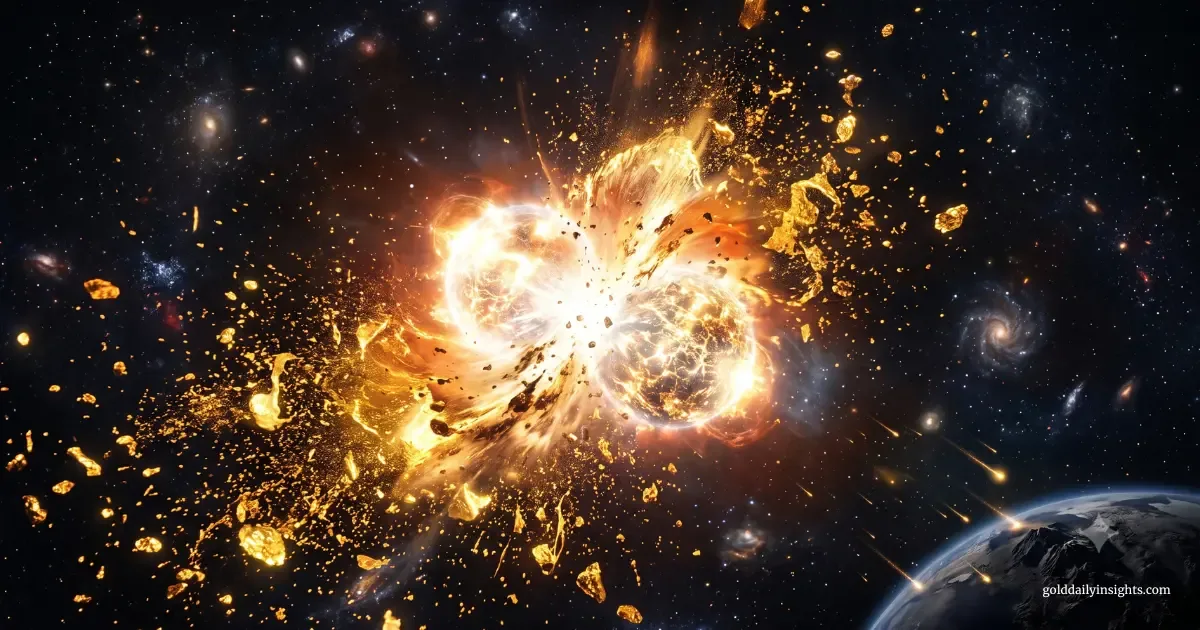
Next time you are staring at a live XAU/USD chart on your MetaTrader 5 terminal, waiting for a breakout and nursing your morning coffee, pause for a second. Have you ever wondered where the physical metal driving those candles actually comes from?
I often spend my days analysing support and resistance, obsessing over central bank rates, and tracking geopolitical tensions. But my reading is that the fundamental reason gold holds such immense value goes far beyond human economics. It is deeply rooted in brutal astrophysics.
The truth is, Earth cannot make gold. This planet simply does not have the power. Every single ounce sitting in bank vaults, inside your electronics, or backing the trades I place daily, is essentially an alien asset. It was born in the most violent corners of the universe.
The Cosmic Forge: Where Does Gold Come From?
To understand why gold is the ultimate hard asset, I always look at how it is created. Unlike elements such as carbon or oxygen, which are formed inside standard stars like the Sun, element 79 (gold) requires a process so extreme that it defies imagination.
In astrophysics, this is known as the r-process (rapid neutron-capture process). It only happens during catastrophic celestial events, primarily when two dead stars—known as neutron stars—collide.
Neutron stars are the ultra-dense cores left behind after massive stars explode. When two of these heavyweights get caught in each other’s gravity, they spiral inwards and smash together in an event called a kilonova. The heat and pressure generated in that split second are so intense that subatomic particles are fused together, instantly forging heavy metals, including gold.
This stellar debris is then blasted across the cosmos. Billions of years ago, before the solar system even formed, clouds of this star-dust eventually clumped together to create Earth. Because gold is incredibly heavy, most of it sank directly to the Earth’s core whilst the planet was still molten.
The gold mined today? That was brought here much later by a heavy bombardment of meteorites hitting the Earth’s crust.
Why Can’t Gold Just Be Made in a Lab?
This is a question I often hear from newer traders: if the world runs out of gold, why can’t it just be manufactured? After all, alchemists spent centuries trying to turn lead into gold, and today there are advanced particle accelerators.
Technically speaking, physicists have created gold in a laboratory. By smashing lighter elements like mercury or bismuth in particle accelerators, scientists can strip away or add protons to create gold atoms. But before I start worrying about this crashing my XAU/USD long positions, there are two massive catches.
Firstly, the process is incredibly dangerous. The gold created in these labs is highly radioactive and unstable. Secondly, the economics simply do not work. It requires an astronomical amount of energy to create just a few invisible atoms of gold. To manufacture a single ounce this way would cost quadrillions of pounds.
In short: it is mathematically and economically impossible to recreate gold on any commercial scale. Earth’s laboratories are no match for a dying star.
What This Means for the XAU/USD Market
Why does any of this matter to my daily trading? It comes down to the absolute certainty of scarcity.
When I trade fiat currencies, I am trading assets that central banks can create out of thin air. A government can print billions of new notes over a weekend. But they cannot print a kilonova.
The total amount of gold on Earth is fixed. All the gold ever mined in human history would fit into a cube roughly 22 metres on each side. It is a finite, extraterrestrial resource that cannot be artificially inflated, downgraded, or synthetically reproduced.
So, the next time the market drops or rallies, I remember what I am actually trading. I am not just trading a yellow metal; I am trading fragments of dead stars. And to me, that undeniable, universal scarcity is precisely why gold will always command a premium.