 Gold Daily Insights
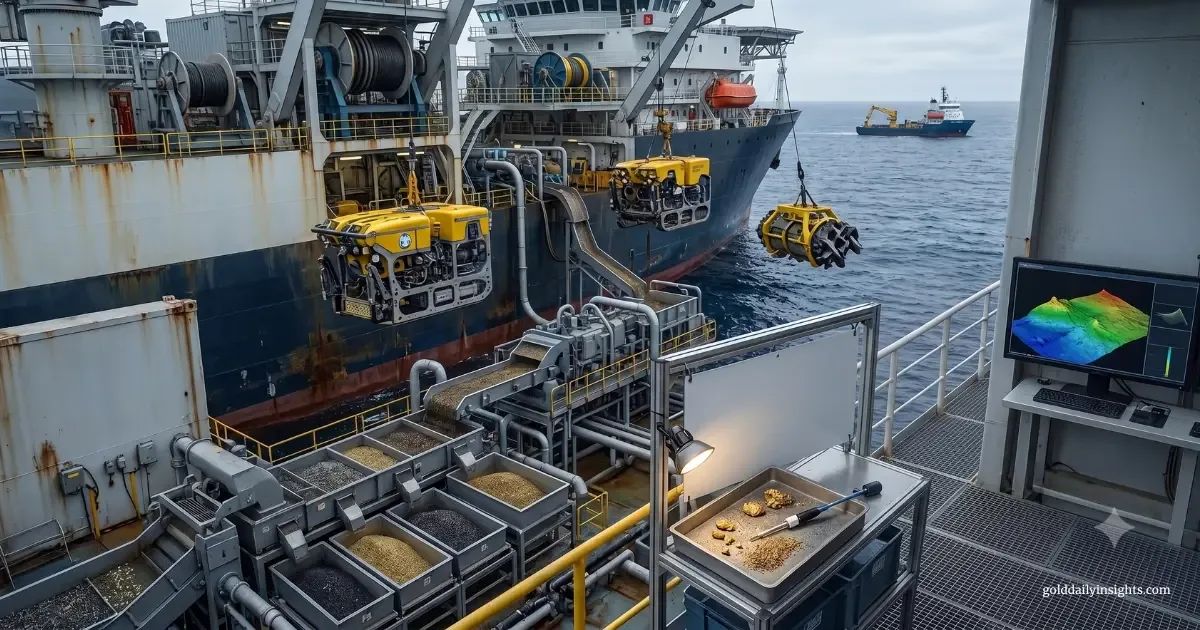
Grab a coffee and let’s talk about a supply shock that, if it ever materialises, would completely rewrite the rules of gold trading. I spend my days analysing chart patterns, inflation data, and central bank purchases to gauge the direction of XAU/USD. But what if I told you the largest gold reserve on Earth isn’t buried in a South African mine or locked in a vault in New York?
It is washing up on the beach.
There are roughly 20 million tonnes of gold dissolved in the world’s oceans. At today’s spot prices, that is hundreds of trillions of dollars just floating around. Yet, despite this massive wealth, nobody is successfully mining it. I want to look at the science keeping this marine gold rush at bay, and whether a technological breakthrough could eventually disrupt global supply.
The Scale of the Hidden Wealth
To understand the problem, you have to understand the dilution. The oceans hold an unimaginable amount of water, meaning the gold is spread incredibly thin. I am talking about parts per trillion. To put that into perspective, one litre of seawater contains roughly a few billionths of a gram of gold.
If you wanted to extract just one troy ounce of gold—the standard measure I look at on my charts every day—you would need to process millions of litres of seawater. It is like trying to find a specific grain of sand spread across a massive desert.
Why Hasn’t a Marine Gold Rush Happened?
It is not for a lack of trying. After the First World War, the German chemist Fritz Haber initiated a massive secret project. His goal was to extract enough gold from the ocean to pay off Germany’s crushing war reparations. After years of testing water samples from across the globe, the project was quietly scrapped. Haber realised that the cost of processing the water was far higher than the value of the gold extracted.
That remains the primary barrier today. The sheer energy required to pump and filter millions of gallons of corrosive saltwater destroys any profit margin. You would spend thousands of dollars in electricity and chemical processes just to retrieve a ten-dollar flake of gold.
Technological Breakthroughs on the Horizon
Science rarely stands still, and modern researchers have not given up on the ocean’s prize. The focus has shifted away from brute-force pumping towards smart materials.
Recently, chemical engineers have been developing highly advanced sponges and metal-organic frameworks (MOFs). These nanomaterials are designed with specific chemical receptors that act like magnets exclusively for gold ions. The theory is that you drop these materials into the sea, let the natural currents wash over them, and pull them up weeks later to strip away the accumulated gold.
While still in the laboratory phase, tests have shown that certain polymer sponges can extract gold from wastewater and seawater with surprising efficiency. The trick now is scaling this up to a commercial level where the materials are cheap enough to produce, and durable enough to survive the harsh marine environment.
What This Means for XAU/USD Traders
So, should I start shorting gold on the fear that the oceans are about to be drained of their wealth? Absolutely not. For now, the XAU/USD pair remains heavily anchored to land-based mining outputs, interest rates, and geopolitical tensions.
However, as a trader, I know the market always tries to price in the future. If a legitimate, commercially viable method of seawater extraction is ever proven, the psychological impact on the market would be immediate. Even the rumour of a scalable technology could trigger sharp sell-offs as speculators price in a potential infinite supply.
Until that day comes, the ocean’s gold remains a fascinating theoretical reserve—a sunken treasure that is chemically locked away, perfectly safe from my active trading orders.