 Gold Daily Insights
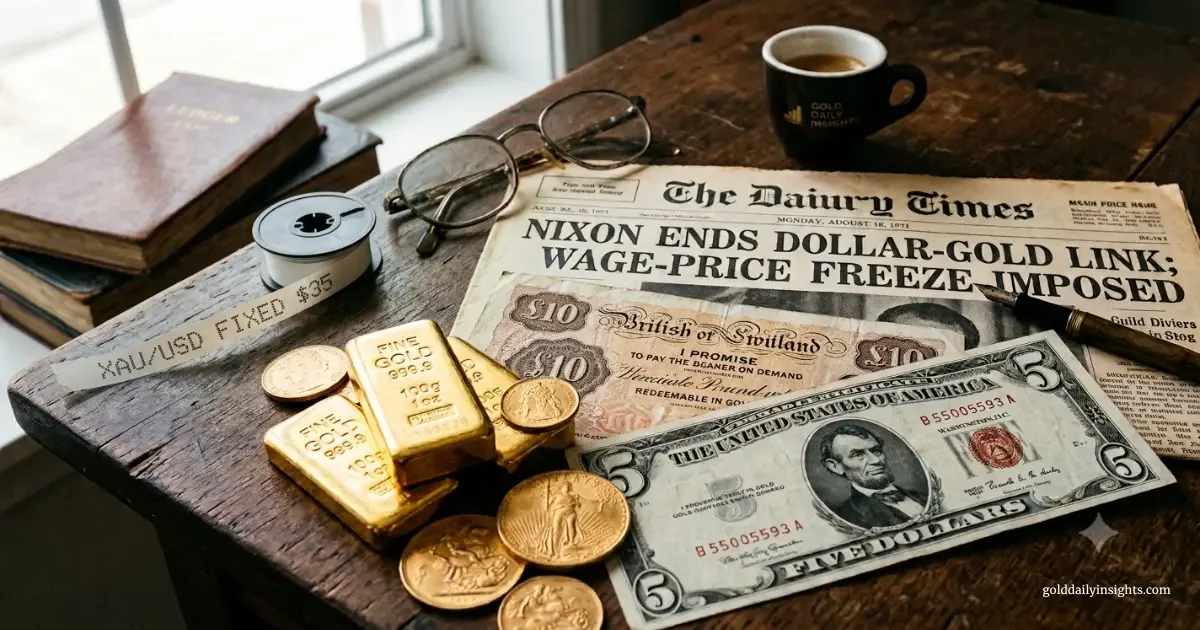
Sitting at my desk with my morning coffee, waiting for the US session to open, I sometimes zoom out on my MT5 charts and think about what money actually is. If you pull a bank note out of your wallet today, its value rests entirely on trust. You trust that the central bank will manage inflation, and the shop down the street trusts that the note will hold enough value to restock their shelves tomorrow. But it wasn’t always this way.
Not that long ago, paper money was essentially a cloakroom ticket for physical gold. If you had a ten-pound note, you could theoretically march into a bank and exchange it for a specific amount of physical bullion.
For modern traders watching XAU/USD fluctuate by the minute, the idea of a fixed gold price seems entirely alien. I want to share my thoughts on how the gold standard actually worked, why the world ultimately tore up the agreement, and why this history still dictates how I trade the metal today.
How the Gold Standard Actually Worked
At its core, the gold standard was a system where a country’s currency or paper money had a value directly linked to gold. You couldn’t just print money out of thin air; if a government wanted to print more notes, it needed to hold the equivalent amount of gold in its vaults.
Britain formally adopted the gold standard in the 19th century, and by the 1870s, most major economies had followed suit. This created a remarkable period of economic stability. Because every major currency was pegged to a fixed weight of gold, exchange rates between countries were effectively locked. A British pound was worth a set amount of gold, a US dollar was worth a set amount of gold, and therefore, the exchange rate between the pound and the dollar barely moved.
It forced governments to be fiscally responsible. Trade imbalances corrected themselves naturally. If a country imported more than it exported, physical gold would leave its vaults to pay the difference, shrinking its domestic money supply and forcing prices down until its goods became globally competitive again.
The Cracks in the System: War and Bretton Woods
The strict gold standard didn’t survive the brutal realities of the 20th century. When the First World War broke out, European nations desperately needed to finance their militaries. You can’t easily fight a global war if you are limited to the gold in your treasury, so countries temporarily suspended the standard to print the money they needed.
After the dust settled from the Second World War, the major economic powers met in 1944 at Bretton Woods to design a new system. They created a hybrid gold standard. Because the United States held the vast majority of the world’s gold reserves at the time, all other currencies were pegged to the US dollar, and the US dollar was pegged to gold at a fixed rate of $35 per ounce.
For a couple of decades, this worked. But the fatal flaw remained: a government’s temptation to spend beyond its means.
The 1971 Nixon Shock
By the late 1960s, the US was spending heavily to fund the Vietnam War and domestic social programmes. To pay for this, they printed more dollars.
Other nations began to realise that the US had printed far more paper dollars than it had gold in Fort Knox to back them up. Countries like France started calling America’s bluff, turning in their excess dollars and demanding physical gold in return. The US gold reserves began draining at an alarming rate.
On 15 August 1971, President Richard Nixon went on television and announced he was “temporarily” suspending the convertibility of the dollar into gold. That temporary measure became permanent. The tether was cut. Overnight, the US dollar became a fiat currency, backed by nothing but the full faith and credit of the US government, and the modern era of floating exchange rates was born.
What This Means for Today’s XAU/USD Traders
So, why does an event from 1971 matter to my daily XAU/USD trading?
When Nixon severed the tie, gold was no longer fixed at $35 an ounce. It was allowed to float freely against the dollar. Over the next decade, the price of gold skyrocketed as inflation ravaged the global economy.
Today, when I trade XAU/USD, I am essentially trading a real-time scorecard of fiat currency performance. Without the discipline of a gold standard, central banks can print money to manage economic crises. I watched this play out clearly during the 2008 financial crash and the recent global pandemic.
When I see massive stimulus packages or central banks aggressively cutting interest rates, I instinctively look to gold. XAU/USD isn’t just a commodity chart on my screen; it’s my primary hedge against the purchasing power of the dollar. The volatility I navigate in the gold market today is the direct legacy of that 1971 decision. Gold is no longer money in the legal sense, but for markets and traders like me, it remains the ultimate, incorruptible store of value.