 Gold Daily Insights
Educational note: this article is for information and education only. It is not financial advice, and nothing here is a recommendation to buy or sell gold or any other asset.
Thirty-one tonnes of gold have been sitting in the vaults under Threadneedle Street since 2019, and the country that owns them has not been able to touch a single bar. Now that stand-off looks close to ending. I have been reading everything I can find on it, and the story is more interesting than the headline suggests.
What is actually on the table
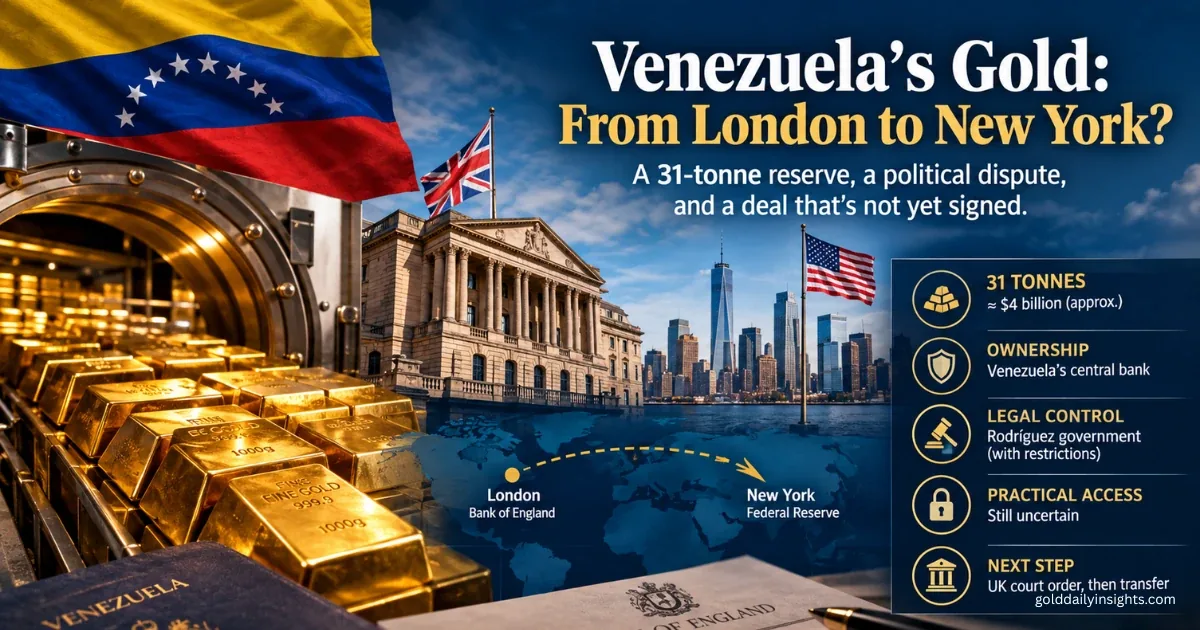
On 18 September the Financial Times reported, citing four people familiar with the talks, that Venezuela’s government and its opposition are close to a deal. The plan is to move the central bank’s gold, about 31 tonnes worth roughly $4 billion, from the Bank of England to the Federal Reserve Bank of New York.
Under the reported terms, the interim government of Delcy Rodríguez would gain legal control of the gold but could not sell it straight away. The metal could instead be used as collateral for government borrowing, including for reconstruction after June’s twin earthquakes.
Nothing is signed. Reuters said it could not immediately verify the FT report, and the technical details are still being worked out. Anyone telling you the gold has already left London is ahead of the facts.
How the gold got stuck in the first place
Venezuela asked for part of its bullion back in 2018, when Nicolás Maduro was in power. By early 2019 the UK had joined dozens of other countries in backing Juan Guaidó, on the basis that Maduro’s election win had been rigged. The Bank of England, acting as custodian, refused to release the gold to anyone while the question of who speaks for Venezuela stayed open.
Two rival boards of the Central Bank of Venezuela then sent conflicting instructions. The dispute went to the UK Supreme Court, which ruled in December 2021 that British courts had to follow the government’s position and treat Maduro as not recognised for any purpose. It sent the remaining questions back down to the lower courts.
At the time the gold was worth close to $2 billion. The price has roughly doubled since, and the case is still not settled.
What changed in 2026
US forces captured Maduro in early January, and Rodríguez became interim president. Then, on 24 June, two earthquakes of magnitude 7.2 and 7.5 struck northern Venezuela. The World Bank put the direct physical damage at $19.6 billion, and the official death toll ran into the thousands.
Inflation made things worse. The central bank reported monthly inflation of 19.9% in July, and economists put the annual rate at around 575%. A country in that position looks at $4 billion of gold it cannot use and sees an obvious problem.
On 12 August, representatives of the 2015 National Assembly and the government signed an agreement to promote the recovery of Venezuelan reserve assets held at the Bank of England, with transparency, traceability and audit mechanisms for how they are used. Rodríguez also wrote to King Charles asking for the gold to be released.
Who controls what
This is where I think most of the coverage gets muddy, so let me separate three things.
- Ownership: the gold belongs to Venezuela’s central bank. Nobody is reporting a sale to the United States.
- Legal control: under the reported plan, the Rodríguez government would hold it, but with restrictions and no immediate right to sell.
- Practical access: this is the real question. One opposition figure was quoted as saying the gold is going to the US but Rodríguez will not have direct access to it, and that it will be supervised and restricted.
The destination itself is not fully settled in the reporting. The FT and Reuters point to the New York Fed. Earlier, opposition deputy Ramón López said the proceeds would sit in a US Treasury account and be audited by international firms. That Treasury detail came from his interview, not from the text of the signed communiqué. My reading is that the two may fit together, with custody at the Fed and money flowing through Treasury-supervised channels, but I would not treat that as confirmed.
The hurdle nobody can skip
Even a perfect political deal does not move a single bar on its own. The Bank of England said it cannot act until there is a further order from the UK court on who has legal authority over the account, and that the parties need to go back to that court. The UK Foreign Office has said the government is not a party to the case and cannot direct or influence it.
So the sequence I expect is a political agreement, then a court order, and only then any movement of custody. Also worth remembering: a custody transfer between central banks does not always mean a truck and a plane. Sometimes it is a change on the books.
Why the gold market itself will probably shrug
This is my interpretation, not a fact. Thirty-one tonnes is around one million troy ounces. World mine production topped 3,600 tonnes in 2025, so this is less than one per cent of a single year’s output. And it is not supposed to be sold. Collateral is not supply.
What I do find worth thinking about is the precedent. Sovereign gold stored abroad can be frozen for years by a recognition dispute. Central banks are watching cases like this when they decide where to keep their own reserves. That is a slow-burning theme for the gold market, and it does not show up on a five-minute chart.
What I am watching
- Whether the parties file back in the UK court, and how quickly a new order follows.
- Whether the final destination is the New York Fed, a US Treasury account, or a mix of both.
- The first loan actually secured against the gold, and on what terms.
- Any wording that softens the ban on selling the metal.