 Gold Daily Insights
This article is for educational and informational purposes only and does not constitute financial advice. I am simply sharing how I personally trade gold across two different market structures.
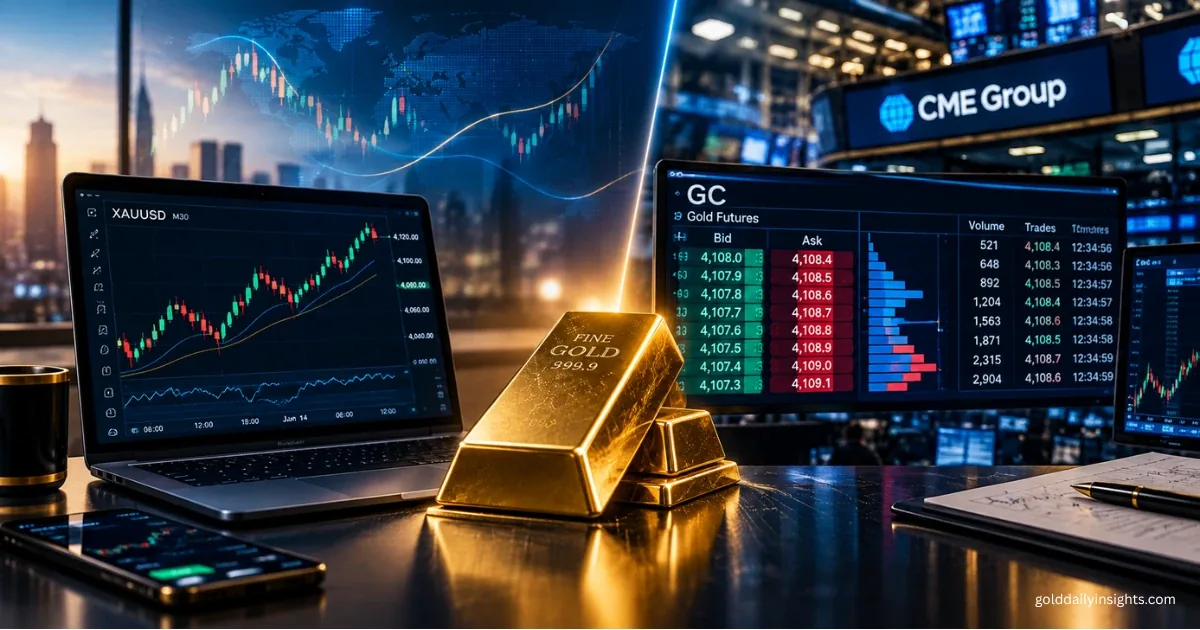
I’ve got two charts open most mornings before the US session opens, and neither of them is showing the same thing. One is my XAU/USD feed from IC Markets. The other is the Gold futures order book from AMP Futures, sitting on top of COMEX. Same metal, same underlying story — completely different plumbing behind the price.
I trade both. I have for a while now, and I’m not writing this to tell you which one you should pick. This isn’t a comparison to crown a winner, and I’ll say that plainly now so it doesn’t need repeating: I use IC Markets and IC Trading for CFDs on XAU/USD every day, and I use AMP Futures to access COMEX gold futures directly, and I do both deliberately, not because I couldn’t decide. What I want to do here is actually explain how each of these products works under the bonnet, because most of what gets written about “CFD vs futures” skims the surface and misses the parts that actually matter to how you trade.
Same Metal, Two Completely Different Market Structures
This is the bit most traders skip past, and it’s the one that explains almost everything else in this article.
When I trade XAU/USD through IC Markets or IC Trading, I’m trading a Contract for Difference. It’s an over-the-counter product — there’s no single public order book behind it. The price I’m quoted is built by the broker, derived from underlying spot and futures gold markets, and my counterparty on that trade is the broker itself (or a liquidity provider it deals through), not some anonymous participant on an exchange floor.
When I trade through AMP Futures, I’m accessing the actual COMEX market — the metals exchange that sits under the CME Group. Gold futures there trade on a central limit order book. Every participant, retail or institutional, is looking at the same bid, the same ask, the same depth. A clearing house sits in the middle of every trade, which is a structural difference I’ll come back to.
My reading of this is simple: the CFD is a convenience product built around the real market. The futures contract is the real market. Neither of those things makes one “better” — they just make them different tools.
How Each Contract Is Actually Built
On the futures side, the standard COMEX gold contract is GC — 100 troy ounces, priced in dollars and cents per ounce, with a minimum tick of $0.10, which works out to $10 per contract per tick. That’s a serious amount of notional exposure. At gold trading somewhere around $4,000 an ounce, one GC contract represents roughly $400,000 of gold.
That’s exactly why the smaller contracts exist. There’s Micro Gold (MGC), at 10 ounces — a tenth of the standard size, with each tick worth $1 instead of $10. And more recently, CME introduced a 1-ounce gold futures contract, shrinking the entry point down further still, with some sessions now running close to round-the-clock. AMP Futures gives me access to all of these sizes, which matters a lot if you’re not trading with an institutional-sized account.
On the CFD side, IC Markets and IC Trading let me size positions far more fluidly. There’s no fixed contract unit in the same sense — I can scale a position up or down in small fractional increments, which is genuinely one of the CFD’s strongest practical advantages for an account that isn’t trading in six figures.
Trading Hours — A Closer Look Than People Give It Credit For
The original assumption a lot of traders make is that CFDs run practically non-stop and futures “close” at the end of the day. That’s not quite accurate, and I think it’s worth correcting properly.
XAU/USD through IC Markets trades close to 24 hours a day from the Sunday open through to the Friday close, with only the briefest of maintenance gaps around the server’s daily rollover point. In practice, it feels continuous.
COMEX gold futures run on a near-identical weekly schedule — Sunday evening through to Friday afternoon, Chicago time — but with one meaningful difference: there’s a genuine one-hour daily halt built into the session for settlement and maintenance. That halt is a hard stop. Orders resting in that window get treated differently depending on your platform, and if you’re holding into it without accounting for it, you can get caught out.
So the honest version is: both markets are open for almost the entire trading week. The CFD’s daily interruption is closer to invisible. The futures market’s daily interruption is short, but it’s real, and it’s there for a specific structural reason — the exchange needs that window to mark the market and run its settlement process.
Spreads, Commissions and the Real Cost of Holding a Position
This is where the two products genuinely diverge, and it’s worth breaking down properly rather than just saying “one is cheaper.”
On the CFD side with IC Markets, I’m looking at a raw spread plus a per-lot commission. The spreads on XAU/USD there are genuinely tight in normal conditions — competitive against most of the market. But that’s not the full cost. Holding a CFD position overnight means paying (or occasionally receiving) a swap charge, based on the interest rate differential and the broker’s financing terms. For a long gold position, that swap is very often a cost, not a credit, and it compounds every night you hold — with a wider charge typically applied once a week to account for the weekend.
On the futures side through AMP Futures, the cost structure is different in shape. There’s the exchange spread itself — usually a single tick in normal liquidity — plus a commission per contract, per side, and on top of that, exchange and clearing fees that get passed straight through from COMEX. There’s no daily swap charge. Instead, the cost of holding a longer-term position sits inside the price relationship between contract months — the basis — which reflects the market’s expectations, financing conditions and storage-related factors baked into the futures curve.
My own rough read on this, from actually running both: for short-dated, intraday trading, the CFD’s cost structure tends to be simpler and often cheaper once you strip out an overnight swap that isn’t being charged in the first place. For positions I want to carry for weeks, the maths starts shifting — a CFD’s accumulated swap can quietly outweigh what I’d have paid rolling a futures contract from one month to the next. I don’t treat this as a fixed rule; I just check the actual numbers before deciding how I want to hold size.
Leverage and Margin: Two Completely Different Philosophies
With CFDs, leverage is set by the broker, within whatever regulatory framework it operates under. In jurisdictions covered by ESMA rules, retail leverage on gold CFDs is capped — nowhere near what some offshore-regulated entities are able to offer. That single fact changes the margin requirement enormously depending on where your account is regulated.
With futures, there’s no “leverage ratio” quoted in the same way. The exchange sets a margin requirement in dollar terms — an initial margin and a maintenance margin — based on the contract’s volatility, and that figure moves as market conditions change. It’s not something the broker discounts or negotiates; it’s exchange-mandated, and if your account balance dips below maintenance margin, you’re looking at a margin call, not a gradual erosion.
Neither structure is inherently safer. High leverage on a CFD account can wipe out a position fast if it moves against you. Futures margin, while set independently of the broker, still requires genuine capital, and a standard 100-ounce GC contract is not a small commitment — which is exactly why the micro and mini contracts exist.
Where the Price Actually Comes From
This is the part of the article I care most about getting right, because it’s also the part most likely to get oversold.
One of the real reasons I keep an AMP Futures account running alongside my CFD accounts is to watch the COMEX order book directly. IC Markets and IC Trading are both excellent brokers with genuinely tight pricing, but a CFD quote is, by definition, derived — built from underlying futures and spot pricing rather than being the primary source itself.
On COMEX, I can see the central order book: bid and ask depth, traded volume, and — separately — open interest, which tells me how many contracts are actually outstanding rather than just how many changed hands. That’s a genuinely different layer of information to what a CFD feed shows me.
I want to be precise about what that gives me, though, because I think this point gets oversold constantly online. It doesn’t let me predict where price is going. What it gives me is additional context — a read on real liquidity, on where size is actually resting, on whether a move looks supported by genuine participation or not. I treat it as one more input into my own reading of the market, not a crystal ball. Anyone telling you exchange data guarantees an edge is overselling it.
And to be completely clear on a point I feel strongly about: this isn’t arbitrage, and I’m not trying to exploit tiny pricing gaps between my CFD price and the futures price. In my own experience, any such gap gets closed by algorithmic participants faster than a retail trader could ever act on it — that’s just how efficient this market has become. I watch COMEX for insight into the real market, not to chase a discrepancy that’s usually gone before I’ve even finished reading it.
Counterparty Risk and Regulation
With a CFD, my counterparty is the broker. That’s not automatically a problem — regulated brokers segregate client funds and operate under genuine oversight — but the risk isn’t zero either. If a broker ran into serious financial trouble, that’s a real exposure, and the protection available depends entirely on where the broker is regulated and what compensation scheme, if any, applies in that jurisdiction.
With futures, every trade clears through CME Clearing, which sits between both sides of the transaction as a central counterparty. That structurally removes bilateral counterparty risk in a way a CFD simply can’t replicate. It doesn’t remove market risk or the risk of your own broker as an intermediary — but the exchange-level clearing mechanism is a genuinely different architecture.
On the regulatory side, it’s also worth knowing that CFDs aren’t available to retail traders in the United States at all — futures are the route available there. Elsewhere, CFD regulation varies significantly by jurisdiction, while futures brokers operating in the US, including AMP Futures, sit under CFTC and NFA oversight.
Expiry, Rollover and the Physical Delivery Question
This is the structural difference I think catches newer futures traders out the most.
A CFD position has no expiry. I can hold XAU/USD for as long as I want, provided I’ve got the margin and I’m comfortable with the swap accumulating. There’s no contract to roll, no date to watch.
A futures contract absolutely does expire, and GC is physically deliverable, which matters more than people think. There’s a First Notice Day — the point from which a long position holder could be called upon to take delivery — and it typically lands before the contract’s actual last trading day, sometimes by a couple of weeks. Nobody trading speculatively wants to be anywhere near that window unrolled. In practice, that means actively closing or rolling into the next liquid contract month ahead of time, not waiting for the exchange or the broker to force the issue.
It’s a genuine extra piece of admin that CFD trading simply doesn’t require. I don’t see it as a downside exactly — it’s just a mechanical reality of trading a standardised, deliverable contract that a synthetic OTC product doesn’t have to deal with.
Why I Personally Run Both
My own setup, for what it’s worth: I execute the overwhelming majority of my actual trading through XAU/USD CFDs on IC Markets and IC Trading. The flexibility on sizing, the lack of an expiry to manage, and the ease of execution through MT4/MT5 suit how I actually trade day to day.
AMP Futures sits alongside that, not underneath it. I use it to watch the real COMEX book — volume, depth, open interest — as context for what I’m seeing on the CFD side. It’s a second instrument panel, not a replacement for the first one.
I don’t think that combination is the “correct” way to trade gold. It’s just mine.
So Which One Should You Actually Use?
Honestly, that depends entirely on what you’re optimising for, and I’d be doing you a disservice pretending there’s one right answer.
If you’re trading smaller size, want flexible position sizing, don’t want to think about contract expiry, and you’re based somewhere CFDs are actually available to you — the CFD route is going to feel a lot more practical day to day.
If you’re in the US where CFDs aren’t an option, if you want exchange-level clearing and genuine order book transparency, or if you’re trading size where the micro and mini gold contracts make sense for your account, futures are worth taking seriously.
Plenty of traders, myself included, don’t see it as a choice at all. I’d rather understand both mechanisms properly and use whichever one fits the job in front of me.